Cabinet Refinishing vs. Painting In Phoenix Kitchens
“Refinishing” and “painting” get used interchangeably in most contractor quotes, and they shouldn’t be. They produce different finishes, cost different amounts, last different lengths of time, and fail in different ways. If you’re looking at Phoenix Valley quotes ranging from $1,800 to $7,000 for the same kitchen, the spread usually isn’t markup. It’s the difference between these two services hiding behind the same word, or a third option (refacing) getting conflated in too.
This guide walks through what each service actually does, how long each lasts in a working Phoenix kitchen, why the cabinet material you have matters more than your color preference, where each option fails when contractors cut corners, and the honest cost math behind the choice.
What Each Service Actually Does
Refinishing means removing the existing finish (stain, lacquer, or polyurethane) down to bare wood, then applying new stain, sealer, and topcoat. The wood grain stays visible. You can change the wood tone, going lighter or darker or shifting warm to cool, but you’re working with the existing species. Refinishing only makes sense on real wood: solid oak, maple, cherry, hickory, alder.
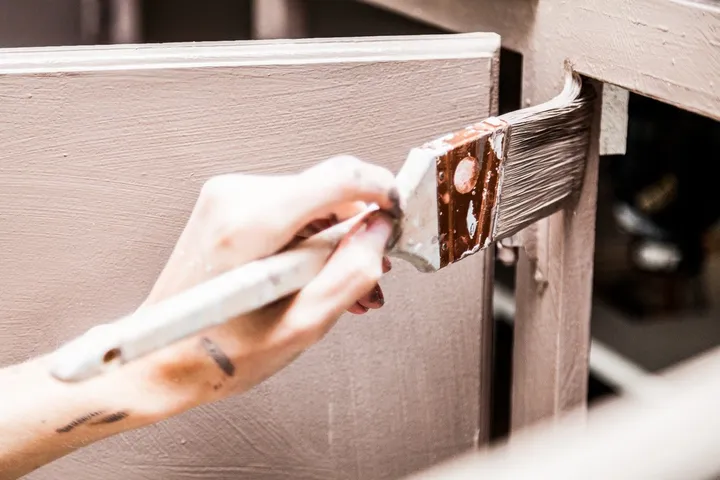
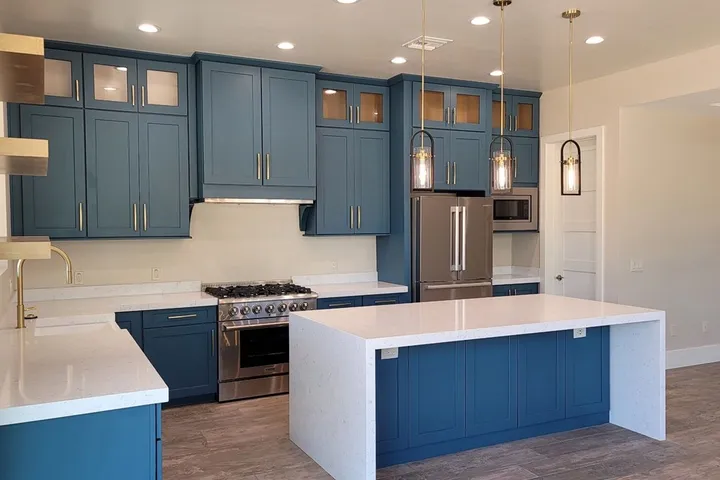
Painting means cleaning, sanding for tooth, priming with a bonding primer, then applying two or three coats of cabinet-grade paint. The wood grain disappears under solid color. Any cabinet material can be painted: solid wood, MDF, thermofoil with the right prep, and even laminate with the right primer system. Color flexibility is the main reason most Phoenix Valley kitchens get painted rather than refinished. White over oak is the single most common ACP cabinet job.
Refacing, which we’re not covering in depth here, is a third option. Refacing replaces the cabinet doors and drawer fronts entirely with new ones, typically wood veneer or 3D laminate, while keeping the existing cabinet boxes. It’s the closest you get to new cabinets without paying for new cabinets.
How Long Each Lasts In a Working Phoenix Kitchen
A properly refinished solid-wood cabinet system, sprayed with a catalyzed conversion varnish or post-cat lacquer and topcoated, holds up 12 to 15 years before edges and high-touch areas show wear. The wood underneath continues to age gracefully. Small scratches blend into the grain rather than standing out against painted color. The finish itself is harder than typical paint film, which is part of why it lasts longer.
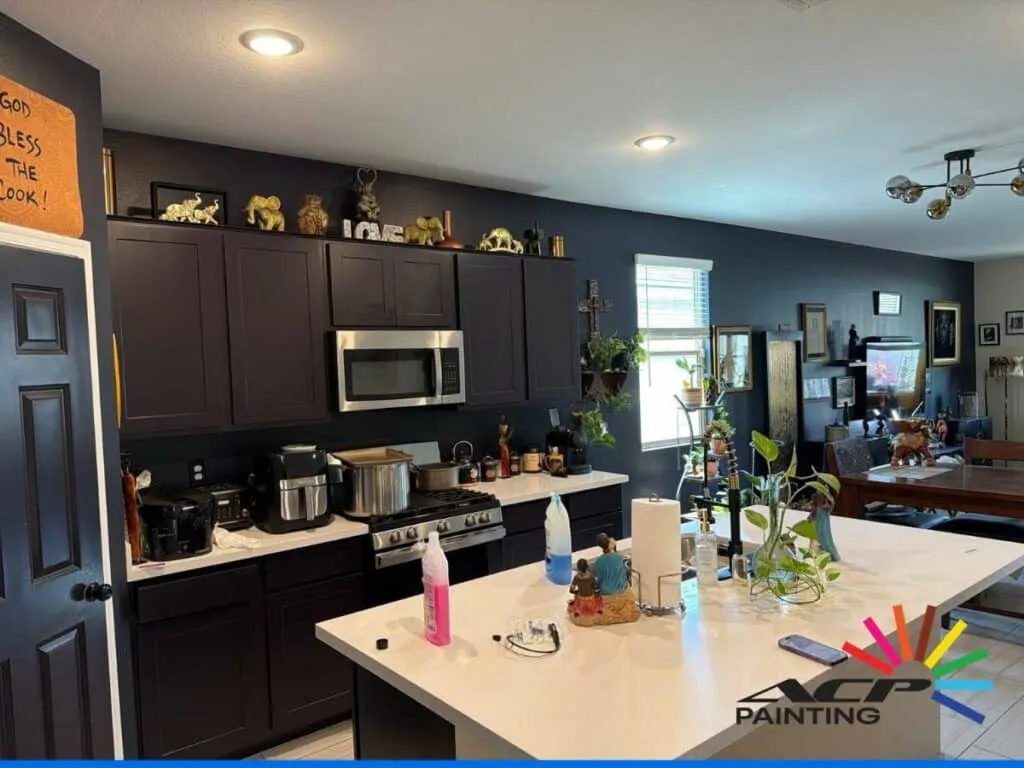
A professionally painted cabinet system, with proper degreasing, bonding primer, and a sprayed cabinet-grade finish like General Finishes Milk Paint or Benjamin Moore Advance, holds up 5 to 8 years in typical use. High-touch areas show wear first: around the dishwasher, under the sink, the drawer right of the stove, and the cabinet doors next to the trash pull-out. White and light gray show wear faster than mid-tone colors because contrast against the wood substrate is higher when chips appear.
That 5-to-8 versus 12-to-15 gap is the most important number in the comparison. Anyone telling you painted cabinets last 15 years is either quoting commercial-grade catalyzed systems most residential painters don’t use, or hoping you won’t be the one to call them in year nine. The 12-15 figure for refinishing isn’t an upsell number. It’s what catalyzed wood finishes actually do.
| “I decided to go with ACP cabinet painting instead of refacing cabinets due to video of detailed process and high reviews. The result was above expectation. Our cabinets look better than new and you would assume they are brand new cabinets and not painted ones.” — Mark Ley · 5/5 stars · April 2026 · Read on Google |
|---|
What Your Cabinets Are Made Of Matters More Than Your Preference
Phoenix Valley kitchen cabinets from the early 2000s through about 2015 are largely oak with stained finish, which makes them refinishable. From 2015 onward, tract builders shifted heavily to MDF doors with thermofoil or painted finish on solid wood face frames. Mixed construction is common in Phoenix homes built in the last decade: solid wood face frames, MDF or particleboard boxes, and real wood or thermofoil doors. Your cabinets may not all be the same material.
If your doors are thermofoil (a thin vinyl film bonded to MDF), you can’t refinish them. There’s no wood to strip down to. You can paint them, but only with proper prep that scuffs the thermofoil enough to bond a primer. We see homeowners told they’re getting cabinets “refinished” when the doors are actually thermofoil and the actual job is paint over inadequately prepped vinyl. Two years later the paint peels at the edges, usually starting near the handles where hands touch the surface most.
If you’re not sure what your cabinets are made of, the test takes 30 seconds. Open a drawer face and look at the back side of the front. Solid wood will show grain on the unfinished side. Thermofoil shows the vinyl wrap visibly stopping at the edge where the door was wrapped. MDF shows compressed fiber: uniform, brown, no grain. A door that’s wood on the front and MDF behind is wrapped construction, common in mid-2010s tract homes.
This single test answers the refinishing question before you call a contractor. If everything’s solid wood, refinishing is an option. If anything is MDF or thermofoil, painting is your only path forward.
| “ACP Painting is awesome! Communication was as good as it gets and the end product was superb! We had all our cabinets repainted and they look brand new. The guys that did the job were amazing and you could tell they took pride in their work.” — Jeff M. · 5/5 stars · February 2026 · Read on Google |
|---|
Where Each Option Actually Fails
The jobs we get called into clean up cluster around two patterns.
Painted cabinets that failed in year three. Almost always a prep problem. The contractor skipped degreasing (kitchens accumulate cooking oil residue in the top inch of every door, especially around the range and microwave, and that residue prevents paint adhesion no matter how good the paint product is), or used a wall-grade primer instead of a true bonding primer formulated for slick surfaces. Paint adhesion fails first along the edges and around handles where hands pull and twist daily. Once it starts chipping, it keeps chipping. Spot touch-up doesn’t blend because the underlying coating shows through the chip, and the spot repair never matches.
Refinished cabinets that look blotchy. Usually a stain-removal problem. Old stain didn’t get fully stripped before new stain went on, so the new color sits unevenly. This is harder to fix than failed paint because you have to strip again, deeper, and sometimes the wood beneath has already been over-sanded by the first refinish attempt. The wood’s character changes when you remove too much grain.
The common shortcut that creates most of this work is spraying without removing doors and drawers from the frames. Cabinet painting done right means doors come off, get tagged, get sprayed flat in a controlled environment, dry properly between coats without dust contamination, and get reinstalled with new hardware. Cabinet painting done fast means everything stays in place, gets masked off, and gets sprayed at angles that leave drips on vertical surfaces and miss the door’s back edges. The job costs 30% less. It also lasts 60% less.
For more on what to avoid, our guide on 8 cabinet painting mistakes homeowners make walks through the contractor decisions that determine whether your cabinets look good for three years or ten.
The Honest Cost Comparison
For a standard 20-linear-foot kitchen (roughly 20 to 25 doors and 5 to 8 drawer fronts), Phoenix Valley pricing in 2026 lands roughly here.
Cabinet painting, properly done: $3,500 to $5,500. Includes door removal, off-site spray, two coats plus a clear topcoat on doors, frame painting on-site with proper masking, and reinstall with new hardware if requested.
Cabinet refinishing, properly done: $4,500 to $7,000. Stripping is labor-intensive and the materials cost more per door. The premium reflects the longer lifespan. On per-year math, refinishing often costs less than painting despite the higher upfront.
Cabinet refacing: $8,000 to $14,000. Different service, different math. New doors and drawer fronts entirely, keeping the boxes. Closest thing to new cabinets without buying new cabinets.
If quotes for the same scope come in meaningfully below those ranges, ask what’s being skipped. Doors-on spray, single-coat application, wall primer instead of bonding primer, and skipped degreasing are the four most common cost-cutters, and the four most common reasons paint fails inside the warranty window. A quote that’s $1,500 cheaper than two others almost always has one or more of these in it.
| “Amazing experience working with ACP, from the color consultation with Julie, to Randy and Oscar knocking out a perfect job on our Kitchen and Bathroom cabinets in just a few days. Extremely happy with the result, will definitely be coming back with future projects.” — Riley Palsa · 5/5 stars · November 2025 · Read on Google |
|---|
What To Ask The Contractor Before Signing
Four questions separate cabinet contractors who will deliver lifespan from contractors who will save you 20% upfront and cost you four years on the back end.
Are doors and drawers sprayed off-site or in place? Off-site is the right answer for any cabinet painting job. In-place spray means dust contamination during cure, drips on verticals, missed back edges, and overspray on countertops and floors regardless of how much masking the contractor uses. The cost difference is real (off-site spray adds labor for removal, tagging, transport, and reinstall), but it’s not optional for a quality job.
What primer system is being used? “Bonding primer” is a category, not a product. Specific products to look for: STIX Acrylic Bonding Primer, BIN Shellac-Base Primer (for stain-blocking on oak grain), or Sherwin-Williams Multi-Purpose Latex Primer with appropriate prep. If the quote says “primer” without naming the product, the prep specification is open-ended.
What’s the cabinet-grade topcoat? Wall paint doesn’t belong on cabinets. The cabinet-grade products homeowners should look for: General Finishes Milk Paint, Benjamin Moore Advance (waterborne alkyd), Sherwin-Williams Emerald Urethane Trim Enamel, or comparable cabinet-specific products. These are formulated for hand-touch surfaces and cure to a harder finish than wall paint.
For refinishing specifically, what’s the topcoat system? Catalyzed conversion varnish, post-cat lacquer, or 2K polyurethane are the answers for a 12-15 year finish. Standard polyurethane or wipe-on stain-and-seal products are not. The catalyzed systems require specialized application equipment and ventilation, which is part of why refinishing costs more.
Frequently Asked Questions
Can you paint over stained oak cabinets?
Yes, but oak’s open grain telegraphs through paint unless the contractor fills the grain with a sanding sealer or grain-filler before priming. Skip that step and the painted finish looks streaked or rough close-up. You’ll see the grain pattern even though the color is solid. Ask specifically whether grain-filling is included in the prep. On oak, it’s not optional.
What’s the difference between refinishing & refacing?
Refinishing strips and restains the doors you already have. Refacing replaces the doors and drawer fronts entirely with new ones, keeping the original cabinet boxes. Refacing costs 2 to 3 times more than refinishing but gives you completely new doors, often in a different door style. Refacing is the right choice when the existing door style is dated even if the wood is fine.
How long should I plan to be out of my kitchen?
Painting properly done with off-site spray: doors are gone 4 to 7 days. Frames painted in place add 2 to 3 days of limited kitchen use. Refinishing: 5 to 10 days depending on stripping complexity. Plan to use the microwave, an outdoor grill, or eat out for a week either way.
Can MDF or thermofoil cabinets be painted?
Yes, with the right prep. MDF needs a primer that seals the porous edges to prevent paint absorption differences. Thermofoil needs aggressive scuffing to break the vinyl gloss before a bonding primer can adhere. Both materials are paintable, but the prep is different from solid wood, and a contractor who doesn’t adjust the prep to the material is going to get a failed paint job.
Do painted cabinets increase home value?
For dated kitchens, yes. A solid white or modern color repaint on oak or maple cabinets reads as updated to most buyers and inspectors, especially in homes built before 2010. The return depends on the kitchen’s other elements: countertops, appliances, hardware. Painted cabinets in a kitchen with original 1990s countertops still read as half-updated.
Should I refinish or paint if I want to change the color completely?
Paint. Refinishing changes the tone of the wood (going darker, lighter, warmer, or cooler within the wood-color spectrum) but it can’t turn oak into white. If you want a complete color change, you need paint. The wood grain consideration is a separate question. Paint hides the grain entirely, which some homeowners want and others don’t.
If you have solid-wood cabinets you like the style of and want to refresh the wood tone, refinish. You’ll get 12 to 15 years and the wood ages gracefully. If you want to change color completely (white over oak is the most common Phoenix Valley request), paint, and plan for touch-up around year six. If your cabinets are thermofoil or laminate, refinishing isn’t an option. Paint is, with the right prep.
The bigger decision in either case is contractor selection rather than service type. The four prep questions above will tell you more about whether your cabinets are going to look good in year five than the choice between refinishing and painting will.
Talk To a Professional Cabinet Painting Contractor
Cabinet work looks simple from a quote: strip, paint, reinstall. The actual difference between a job that holds up for 10 years and one that’s chipping at year three is in the prep specification, the topcoat selection, and whether doors come off for off-site spray. If you’re comparing cabinet quotes and the prices are spread across $2,000 of difference, our team can walk you through what’s actually included in each.
Call our Maricopa office at 480-785-6323 or request a free in-home estimate. We serve homeowners across Maricopa County and northern Pinal County from offices in Maricopa and Scottsdale, with crews working in Ahwatukee, Chandler, Gilbert, Tempe, and Casa Grande.
For more on our cabinet work, visit our cabinet painting service page or browse our cabinet painting gallery for examples of completed Phoenix Valley jobs.
| About the Author Russ Byers — Co-Owner & Master Painter, ACP Painting, LLC Russ has been working Phoenix Valley cabinets for 20+ years. ACP Painting is a veteran-owned business serving Maricopa County and northern Pinal County since 2005, licensed under AZ ROC #294240 (CR-34). Read more about our team |
|---|
Related reading
5 Reasons to Choose Cabinet Painting Over Cabinet Replacement
For homeowners considering tearing the kitchen out and starting over. Covers the cost, timeline, and disruption math.
7 Steps in Painting Kitchen Cabinets
The detailed prep-through-finish process that determines whether painted cabinets last 5 years or 10. Useful for evaluating contractor quotes.
8 Cabinet Painting Mistakes Homeowners Make
The decisions that fail painted cabinets, from primer choice to spray-in-place shortcuts.
Mix Cabinet Colors with the Two-Tone Kitchen Trend
For homeowners committed to painting and wondering about color strategy. Covers the upper/lower contrast that works in Phoenix Valley kitchens.
5 Expert Tips to Match Your Kitchen Cabinet & Wall Colors
Color coordination for kitchen repaints. Useful once the refinishing-vs-painting decision is made.
Service areas
Off-site spray, bonding primer, cabinet-grade topcoat, two-coat application standard. Includes hardware reinstall and optional new hardware.
Kitchen walls, ceilings, and trim work that often accompanies a cabinet repaint for a coordinated kitchen refresh.
Color selection for cabinet paint, including the increasingly popular two-tone upper/lower combinations and accent island colors.

Maricopa
20987 N John Wayne Pkwy
Maricopa, AZ 85139
Phone: 480-785-6323
Scottsdale
8350 E Raintree Dr Ste 215,
Scottsdale, AZ 85260
Phone: 480- 764-3735